

A Conversation with Rebeca Ventura, Fine Artist of Arte Gorda

I met Rebeca (she/her) for a call from her home in Berlin one Tuesday morning. Fine artist, caring and energising person, I just knew it was going to be an amazing conversation from our messages to one another online. You will not be disappointed, so I’ll leave Rebeca to tell us about her artistry.
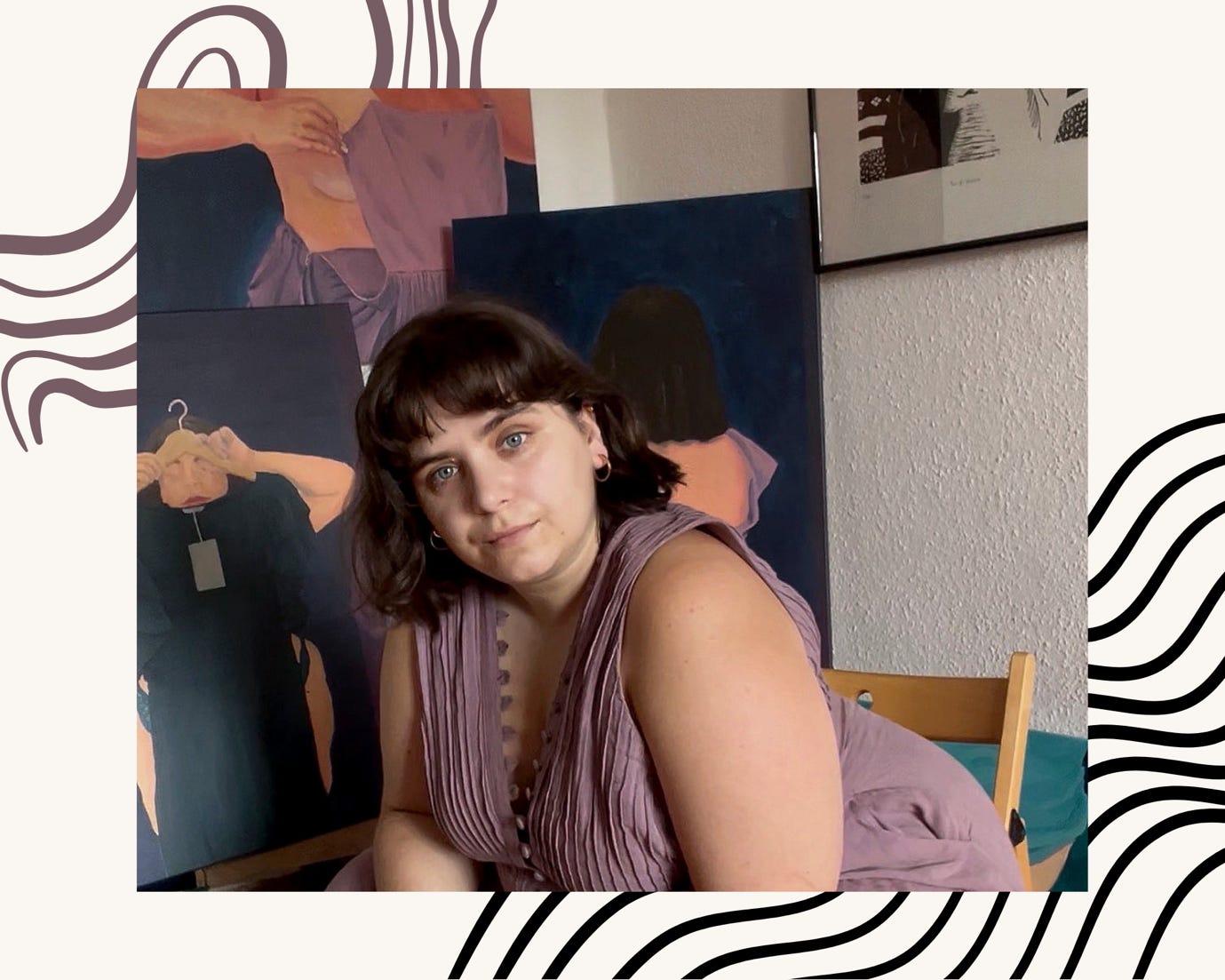
Photograph of Rebeca
Arte Gorda was a way to creatively express myself which started over two years ago now. I’ve created art my entire life, but mostly as a hobby. I had a big burnout from my last office job and had to take time out, re-think what my priorities were. In that time, I was using art to cope with my mental health, including body image struggles and an eating disorder of over 15 years.
I started posting my art online, people were reacting to it and so, in 2024, I decided to take it more seriously. I was getting educated on fat liberation at the time and thinking of the word fat as something neutral. Even though I mostly work in English, in my mother tongue the word for fat, gorda, felt heavier to me, like it had a lot more negative connotations. It was important for me to flip that. This is why the name of my artistic practice is in Portuguese: Arte Gorda. In the last two years I’ve had the luck to see my practice grow and professionalise in the art field which has been a dream come true.
That’s incredible!
Something I really notice in your art is that that there’s an intentional approach. You put a lot of thought and time into everything you do. Reading your Substack, you talk about representing diverse bodies in what you create and always looking to make sure that you’re being inclusive. There’s also a cheekiness and a playfulness to a lot of your art as well.
I think one of the things that hit me and helped me the most during my recovery was seeing bodies like mine on social media. That showed me how crucial representation is, just seeing yourself out there, seeing people like yourself being happy, and that’s why it was important for me. Representation really is a cornerstone of my work.
When I started painting, I was mostly painting bodies like mine (white and hourglass-shaped) and then through conversations on social media, I realised I should be more inclusive of other body types. It became a very intentional journey to diversify, and it’s a balance I try to maintain in a respectful way. I obviously don’t want to speak for bodily experiences that I don’t have specifically, or one where I might be more privileged. My goal is not to speak for people but rather to make sure I don’t cut them off the stage I’m creating.
The intentionality behind it is very big. I do think and plan a lot for each piece and each series. I’ve been told I should be more spontaneous, especially in art school. It was a lot about think less, just let it flow, and get it out. That’s something I’m also still navigating and figuring out. I’ve always been very organised, wanting to plan and structure things. I think that’s clear in my art, and I don’t think it needs to be a bad thing. I’m very curious to see where the art will evolve to because it’s for me sometimes also a surprise. I have no clue what I’ll have created in a year from now. So, we shall see.
In your work there’s also something about bringing into the light things that are taboos. So, for example, your Woman Ate series which are paintings of people who may have eating disorders or be in bigger bodies eating in public and eating foods that aren’t just labelled as ‘good’ foods, which we’re taught about in society. I think this series is very, very interesting and it gets a conversation going.
When I’m in exhibitions or at art markets, I have very different conversations with very different people, because the project speaks differently to everyone. At one point someone described my art as, “your message is: big is also beautiful”. And yes, it is, but I do try to get into the specific challenges that we face in bigger bodies such as not always getting medical access, inaccessibility of the fashion industry. Sometimes it’s about identity. So, it’s about beauty, but it’s also about much more than that. It’s about the fat experience really, and I do want it to be something that specifically fat people see themselves in and see the challenges that they face talked about.
I aim for a hopeful note, something positive about how we can build a different future, one that is community centred. But there are times where I also struggle, especially if I am facing challenges in my personal life and some works may become more critical and more negative. I think that’s also okay. I’m giving myself space for both.
I do not want bigger people to feel like they should shy away from so much in life, to take up less space, that our issues are better not mentioned at all so that people don’t notice we’re so big. The biggest aim of my work is that I want people to see. I want things to be there, visible, so no one can ignore the challenges that the body is currently facing.
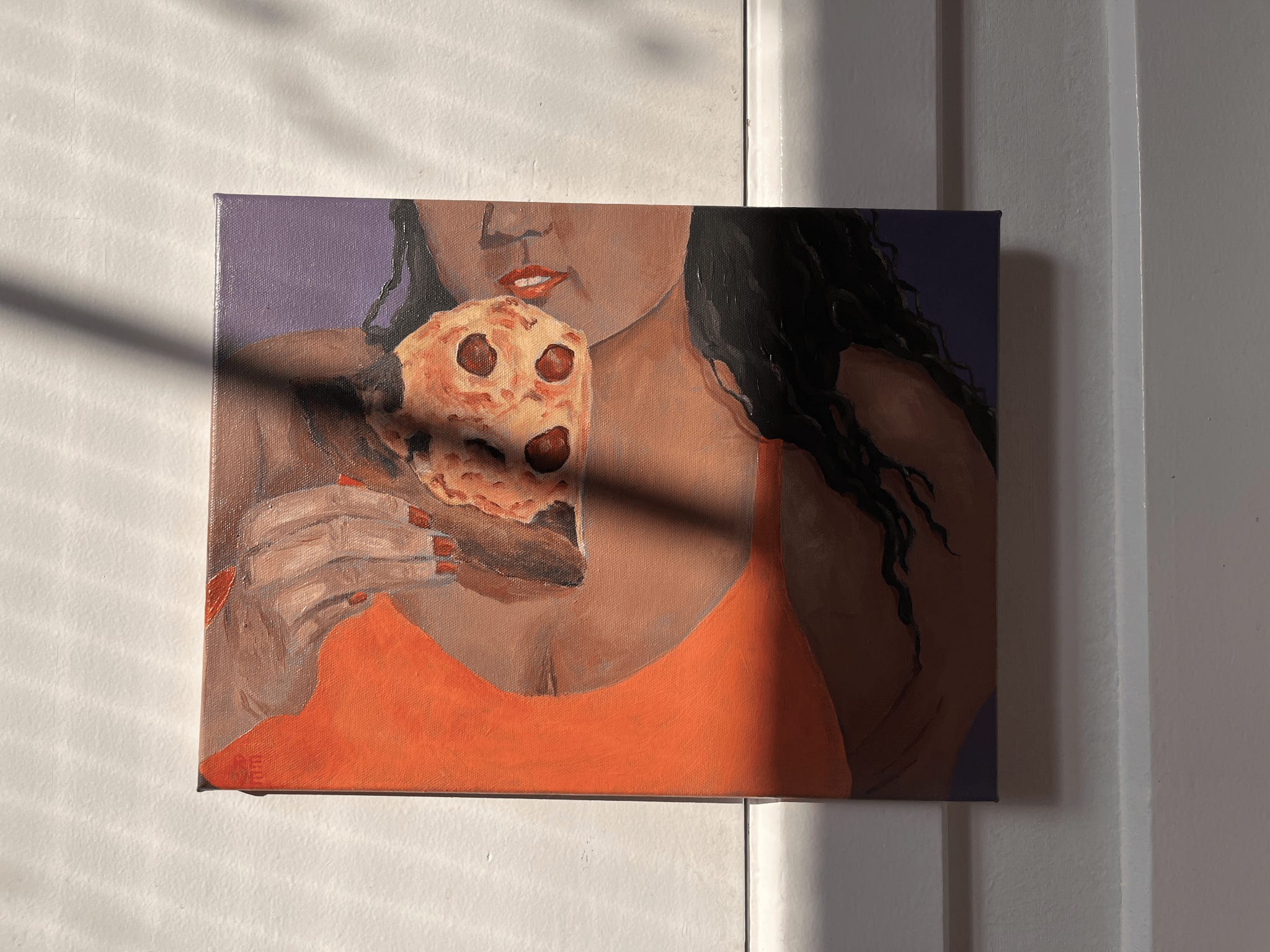
Photograph of an artwork from Rebeca’s Woman Ate series
I’m thinking of the Woman Ate series. There’s a particular image (Rebeca has shared with us, above) which shows part of a face and is focused on the food someone is eating. I found this a very interesting take, as it zooms in on certain aspects.
I did an art mentorship program where we discussed that in a lot of my pieces there’s not a specific identity, a face that is recognisable. For me, it has to do with the fact that it is not a one-person experience. It is the experience of so many of us. That piece focuses on the eating act. So, for me, the mouth being there was absolutely vital, the rest was not the focus in that moment.
It’s definitely a question I’ve been pondering for myself in the last year or so. In mainstream advertising the headless fatty is a fat body where the head is cut off, and you just see the body. Such imagery takes away our agency and this angle could also be read that way in my work. It is not how I would like it to be read though. My approach has to do with a problem that touches more than one of us and this is what I am trying to communicate in the way I focus a work.
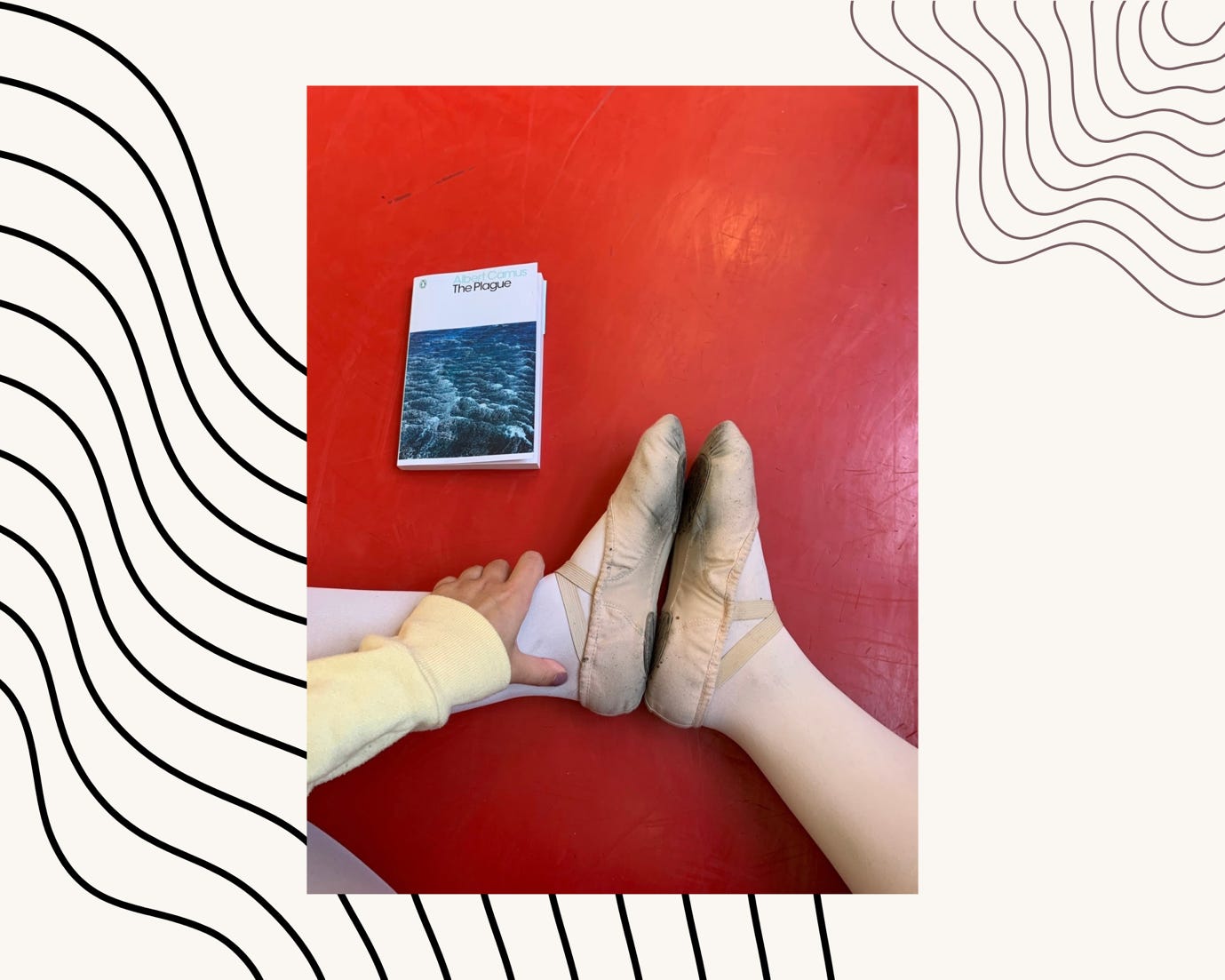
Photograph of Rebeca taking ballet as an adult
Art in childhood
As I mentioned in the beginning of our talk, art has been a part of my life in many different ways. As a young kid I took ballet and piano classes and was painting by myself as a hobby. I refused to take art classes until my late twenties even though my family offered. I thought, “no it’s not worth it; it’s just a hobby”.
My family didn’t sign me up for ballet so it wouldn’t be something I did by default just because I was a girl. I think I’m at core a very feminine person and at the time I just loved ballet skirts and all the pink. I begged for classes for a full year before they signed me up and I was so happy when it happened! I did ballet for the next twelve years, but it was always a double-edged sword. I loved how the movement made my body feel and the moments just before going into stage with my fellow dancers, but it all came with its challenges.
In the early 2000s there was so much pressure for us to be so thin, and I was the biggest person in class (I wouldn’t call myself fat back then, but chubby). My eating disorder started around that time as a young teenager, and I think ballet was a big part of that unfortunately. I was told a lot of the time that I needed to lose weight, that I wouldn’t be able to hit this or that pose unless I did. So a long obsession started. It’s a bittersweet memory. I stopped ballet for years when I went to university and retried it again as an adult after moving to Berlin. It is not a part of my life at the moment. I’m trying other dance styles, but I still hold a lot of love for it, and I do see myself going back at some point. This would need to be on my own terms without having to change anything about myself, doing what my body enables me to and not trying to shape the body to the medium.
I believe the lightness in my art, a certain romanticism and the way I move through life, definitely originated there. Part of the grounding sense in my art came from ballet and piano classes because both of them demanded a lot of repetition and training and patience.
The symbolism of the book beside Rebeca in the image, above
I am definitely an introvert. I need low time every now and then. In ballet, there is a lot of community, getting ready together, rehearsing together, always together which was lovely, but I did need my moments to withdraw.
Books were always a bit of a salvation place where I would just immerse myself, and I would tend to bring them with me everywhere. I have such a clear image of me as a young teenager in my ballet suit, going into class holding my little book. It was always there for me on the floor in the corner when I needed it, if someone else was doing their dance, I had a break time or if we were stretching
How Rebeca stepped into her space as an artist
A lot of what informed my decision not to take art classes as a youngster had to do with the financial situation I grew up in. I was making decisions about high school and university at a time when Portugal had just gone through the 2008 financial crisis which hit the country quite hard. The mood was always to pick a safe field of study and job.
Looking back now, I see that I found myself cutting away the things I love, stripping back to what I was good at and what would make me money to sustain myself. I remember very quickly denying myself literature, which is something that was always a big part of my life. I also remember I considered studying mathematics, but my family said, “why not engineering? It’s more practical” That’s how I ended up studying engineering but hated every minute of it. I did not pursue a career in the field.
Once the burnout happened, I had to really put a break in my office job. I went to therapy and we really deconstructed what am I passionate about? Why was I denying myself? And how to actually start taking a chance in those spaces. Step by step it gave me the courage to give it a try with the support of my therapist, my friends, my partner, and it didn’t seem so scary. My mindset for a long time was that I can always go back to my old job, let’s just try a little bit longer. And suddenly things started working out. And now, thankfully, I do not see myself going back, nor do I want to. I finally understand the people that get out of bed and are happy every day. I’m not dreading my job 24/7 , which I used to. I’ve found purpose and a community.
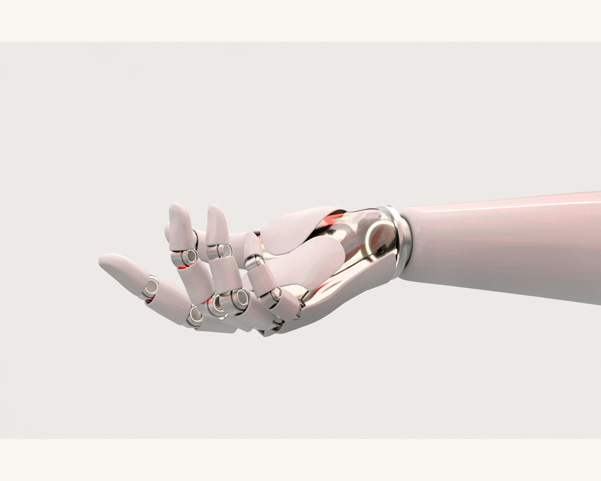
Next we discuss an AI project where Rebeca was a featured artist. Rebeca was asked questions by strangers (who remained anonymous), instead of them asking an AI chatbot. Rebeca created an artwork in response to a selection of their questions, and we now discuss the project.
I don’t use AI myself and AI has been a conversation topic with friends for a while. There are things that are sometimes easier to share with strangers than with people we know. There is this anonymity, “I don’t care what this person thinks about me”, “we might never see each other again”, so there’s a certain freedom that comes with it. And I believe that’s what that project used, and why it worked so well.
At the time I did not expect how much every single question had to do with how to connect with others. I found that so surprising because instead of turning to a friend and connecting with that friend about an issue, people are turning to a machine to ask them how to do that, which felt so nonsensical to me at the time. There is fear of course involved, and so if there’s an easier way to ask without risk, without rejection, that’s why people might tend to take it.
I recall one of the entries did not have to do with how the person perceived her own body, but how she perceived others perceiving her body. This felt to me a little bit like a room full of mirrors in taking how others perceive us to affect how we feel ourselves, and the exhaustion of this constant exercise.
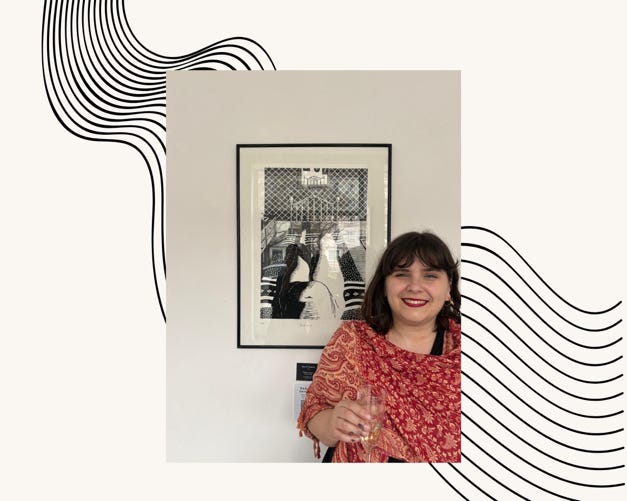
Photograph of Rebeca standing in front of her piece ‘Box of Dreams’, created in an AI-focused community project
Next, Rebeca describes Box of Dreams and the project, for us
I thought long and hard while creating this piece: how do I do this? Do I just want to communicate what I learned from what people asked? Do I want to also give my own answer? I thought that was important, too. From my own fat liberation journey, what I realised was these expectations have to be removed, because it’s often us putting them onto ourselves. Other people have fears too. Other people also worry about their bodies and often they’re so consumed by that, they’re not even noticing ours. And so, if we are okay with them, it’s easier to go outside, to go to the beach, to go wherever and actually connect with other people. There are obviously still societal barriers, places where we can’t enter because of accessibility and discrimination. But I do feel that the connection with others specifically does become easier when we can say no to these expectations - that others might put on us and that we often put on ourselves too.
With linocut I often work with black and white. Different colours can be used, but I want to continue the tradition of the medium’s political history in the 20th century in South America and Europe. Also, with the dichotomy of the black or white, the piece goes back and forth between fear and hope. When things don’t work out and we restrict ourselves, we might give up. And sometimes things do work out, and we are able to unburden ourselves or find help in community.
I wanted the setting to be private, because the conversation with AI is so individualistic: it’s the person and the machine. The bedroom made perfect sense because it can be a hideaway place. It’s such a common experience to cancel plans because we don’t want to go out in our fat bodies. We stay in. But I needed an alternative and that was the rest perspective. Someone who has found peace with themselves and with their body, doesn’t need to be constantly on the move to try and shrink, and they allow themselves the revolutionary act of rest. That feels like such a defiance, especially when you live in a bigger body.
Then there is the open box of dreams which is in the little kommode in German or chest-of-drawers in English. There was a specific entry that I connected a lot to my experience with burnout, as someone [in their AI question for me] was saying, “when can I stop my day? I have so many things to do, so many tasks. My day is so full and I have so many dreams, but the day feels like a box. And I’m just trying to stuff them in, and I almost can’t close the box anymore”.
I myself had this connection to art for so long, but I never allowed myself to even look at it. I was just stuffing it into a box and at some point, I couldn’t anymore. I had burnout. I was lucky enough to have the chance to open that box and look at those dreams and see what I actually wanted to do. The box being open in this part of the artwork symbolises exactly that. Is it that the box can’t close anymore and it’s just overflowing and we’re too tired to deal with it (which can happen)? Or is it that perhaps they are having a moment to stop and say, “let me look at this”. Perhaps the person got the time and resources to start trying out their dreams? A little bit of a dichotomy here as well.
At the top of the picture there is a mirror and the top of the bed is visible but not the actual person (going back to the theme of anonymity!) There were two reasons for this: On the one hand there are moments when it is so difficult to look at our body. The love is not there, and we just see all the flaws. I also had moments in my life where I just ran past mirrors because I couldn’t afford to stop and look at myself. On the other hand it can also be read as someone who is so comfortable with their body that they don’t need to obsessively check it. Do I feel good? Yes, that’s all that matters. So it’s possible to finally achieve a state of rest.
How Rebeca moved to Berlin
I always had this dream of living abroad as a teenager. I was fascinated by London but by the time that I had the chance to actually move abroad, Brexit had just happened and I wasn’t so sure about the UK anymore. I started looking more into central Europe. It was a spontaneous decision for someone who’s such a planner. I looked into different cities, different job opportunities and it was the first thing that showed up that made sense. I was very happy to go to language classes, met a lot of other internationals, eventually met my partner and delved a little bit more into the German and Berlin worlds.
What would you say is coming up next for you?
At the moment I’m focusing on technique as I’m going through an experimental period. I’m trying different mediums, revisiting things that I had tried in the past and thought are not for me. I’m considering, how do I want to keep communicating?
I also find myself perhaps entering a bit of a nostalgia era. I’ve been in Berlin for seven years now, and I miss home a lot and find myself feeling a need to go back at some point. And while I still miss home, I’m also looking at Berlin and starting to imagine what I’m going to miss here.
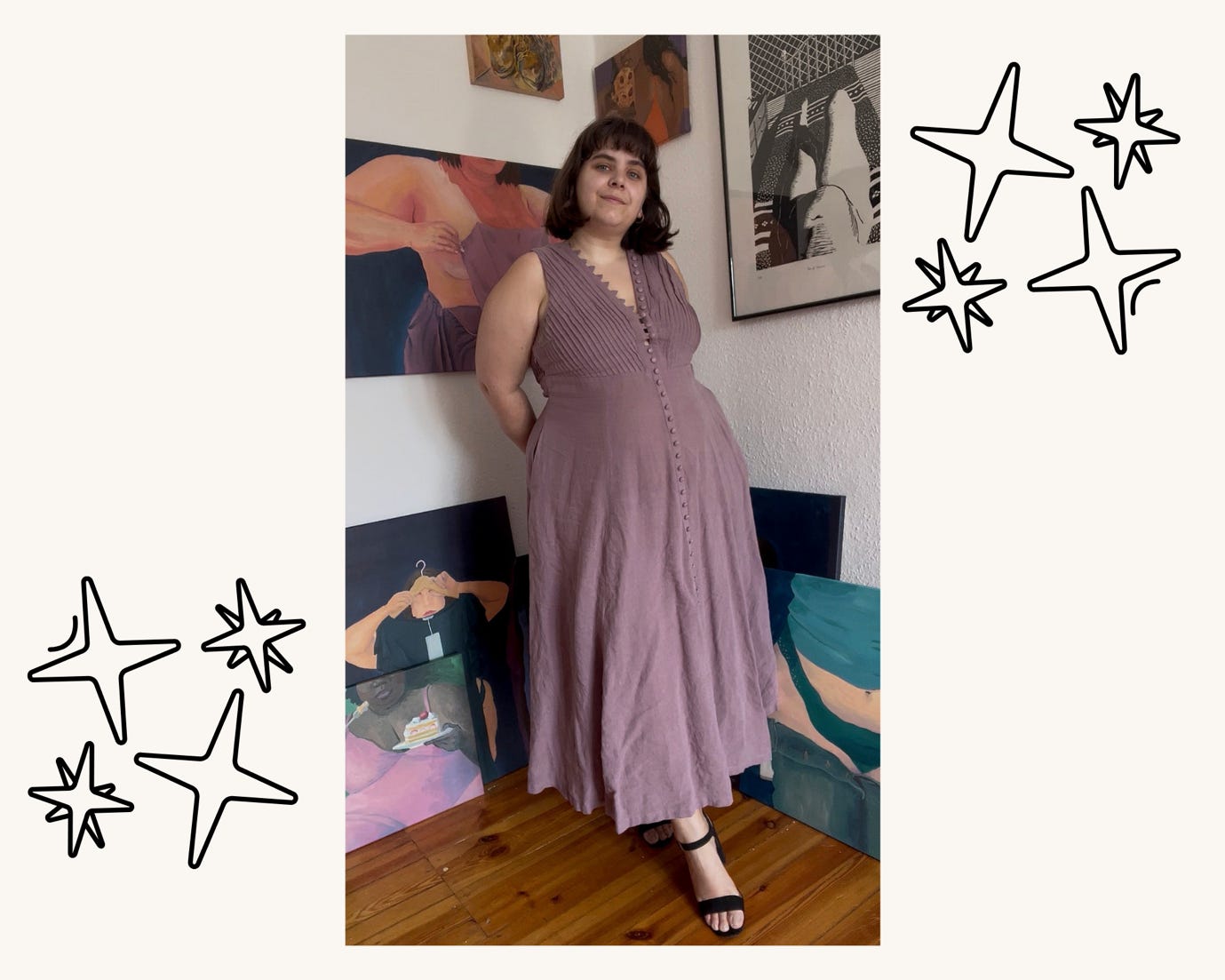
Photograph of Rebeca
Links Rebeca would like to share with us:
Rebeca's website for Arte Gorda
A final link with a message from Rebeca:
If you would like to not lose touch over social media algorithms, I highly encourage you to join my newsletter at https://artegorda.substack.com/subscribe - I write a letter once a month with updates on my artworks, events and thoughts on fatness and art.
I found this conversation fascinating and inspiring - like visiting a gallery for an afternoon and reading all the accompanying notes alongside looking at the works. Thanks so much for sharing!