

Finding Your Ikigai (Reason for Being)
Article 1/4 in this series about clarifying your life path

Reaching a fork in the road of my life, and considering going down the least travelled option, I tried three things that really helped me to navigate this pivotal shift in direction. I will be releasing four articles on this topic:
1. Finding your Ikigai (reason for being) - which this article will look at
2. Refreshing your core values
3. Getting to the bottom of your why
4. Changing course

Last year I reached a fork in the road. There was a familiar direction to take (my established career as a therapist) and a new, mostly unexplored path (I had always created music, for example, but the new direction involved re-centring my life around a bunch of fresh ideas!) Before taking the latter option I needed to build clarity to inform decisions. So, I read many books, listened to countless podcasts and found three exercises that really helped me to try the new path, finding ultimately that the changes I made rippled out across my whole life in a bigger way than expected, affecting relationships, my lifestyle and my future plans.
Today we are looking at the first of the three exercises: clarifying our Ikigai.
Your Ikigai lies at the intersection of what you’re good at, what the world needs, what you love and what you can be paid for. It is about life purpose, joy, and can inform every part of our lives.
Sometimes we do things because it’s how they’ve always been done. But sometimes, patterns start to feel like they aren’t working for us anymore. We can squirm and resist, but gradually, the curtains that shroud our true wants may start to slip away as our self calls us to make changes. This sounds dramatic, and I would add a caveat that sometimes things can be little shifts, akin to a small silky shawl falling to the floor, but, for me, it was a huge change like a theatre curtain lifting to reveal a whole world unseen until that moment.

GIF by @khyatitrehan
Having worked as a therapist for over a decade, I came to see my role as a therapist to be primarily about instilling hope through unconditionally believing in my clients, and their ability to work through what they brought to sessions. Whether we go to therapy or not, so many of us experience periods of time where we might feel a little lost or troubled on our paths, especially when who we are is shifting naturally as we grow and age.

A beautiful photograph of the ocean
When the documentary Live to 100: Secrets of the Blue Zones came out on Netflix in 2023, I watched an episode about the blue zone in Okinawa, Japan. For context, there are presently five blue zones on the planet where people have been recorded to live the longest, and this term was created in collaboration between researcher Dan Buettner (who made the documentary) and National Geographic.
The documentary interviewed older people from Okinawa, seeking to discover their take on why the region had recorded some of the highest concentrations of centenarians in the world (people who live to 100 + years of age). Dan and the team put together a list of factors they identified in these interviews including things such as nutrition. One of the other factors identified was a sense of feeling connected and of service to the community, which seemed to go hand-in-hand with another factor, each person’s Ikigai, or reason for being. The residents described their individual Ikigai as something they considered important in fuelling a long and healthy life, connecting them to the people around them.
I was so inspired watching this episode that I immediately began to read about Ikigai, but it wasn’t until last year that I looked at it again, reaching that fork in the road I mentioned. I found a standard Venn diagram everywhere that was originally created by Marc Winn (below), drawn from an original ‘Purpose Venn Diagram’ by Andrés Zuzunaga.
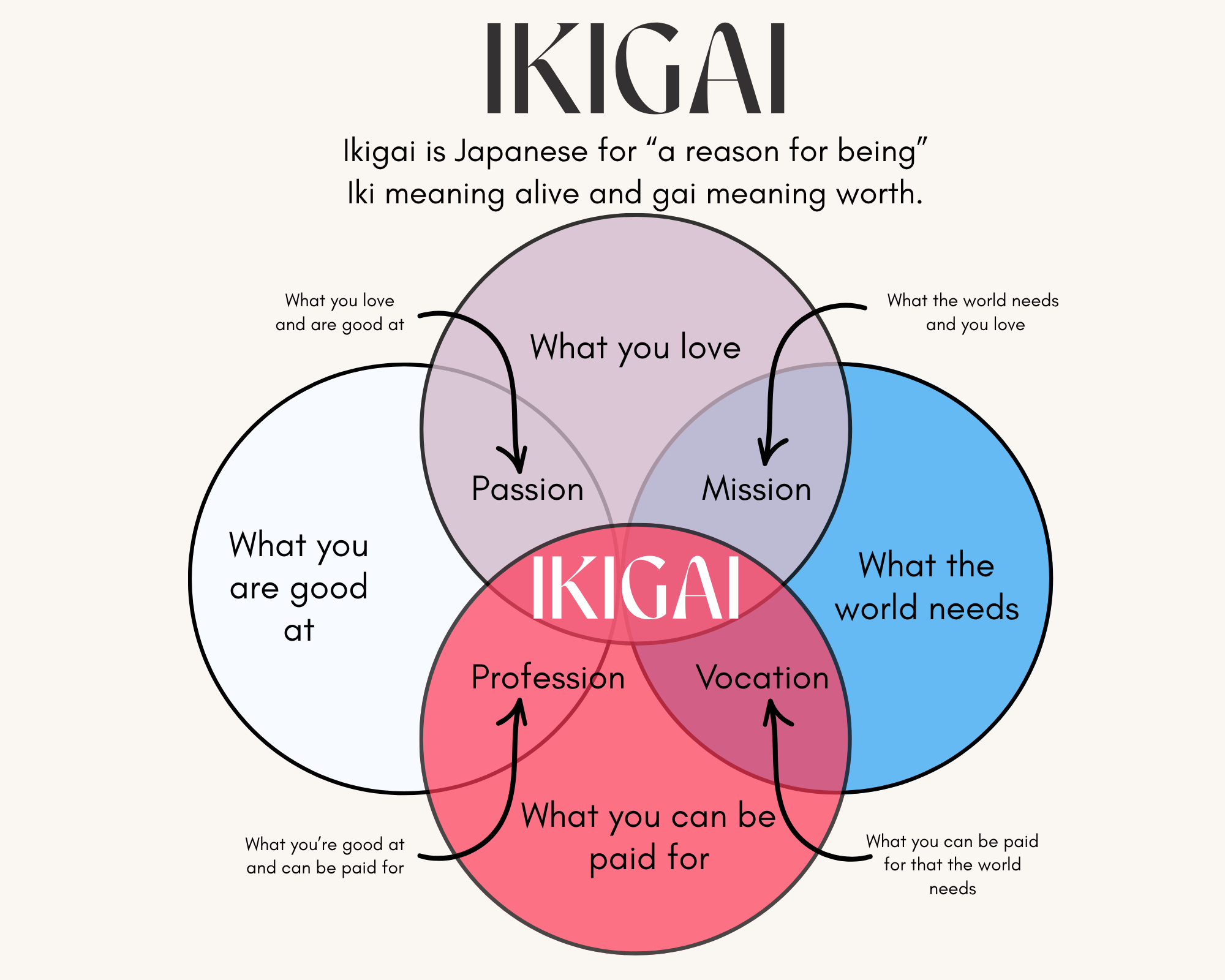
Image created in Canva using Marc Winn’s Venn diagram
Western culture has produced many books and articles about Ikigai, and I should note here that being far removed from the local culture of Okinawa, and not speaking Japanese, what I say in this article is drawn from trialling Marc Winn’s Venn diagram, and the other things I have learnt about Ikigai in random places.
To get started, completing the Venn diagram was something I jumped into with great joy (I say that with a cheeky smile as someone who genuinely loves things like this!) It felt like putting a puzzle together, and brought a sense of achievement, clarity and satisfaction which is why I’m sharing it with you!

GIF from GIPHY of Sir Forrest Gump
You can have a go at creating your own Ikigai map using the PDF I’ve left for you below - feel free to let me know how you get on!
It also feels important to say that once you are clearer on your Ikigai, you can talk about it with your trusted people and bounce ideas off them, and perhaps look at new ways to thread it through your life.
Areas where you could consider applying your Ikigai:
- The work or volunteering you do or would like to do
- How you connect to or serve your community
- The relationships you surround yourself with
- Your self care
I believe this is a process, and isn’t about achievement or reaching a final goal. I have no doubt that you’ll find much of what you already do day-to-day stems from your Ikigai :)
Take what’s helpful and leave the rest, my friend!
Elle
Bonus: I have made a free Ikigai PDF you can download, below:
