

Part 2: A Conversation with Rebeca Ventura and Her World of Arte Gorda
Part 2/2

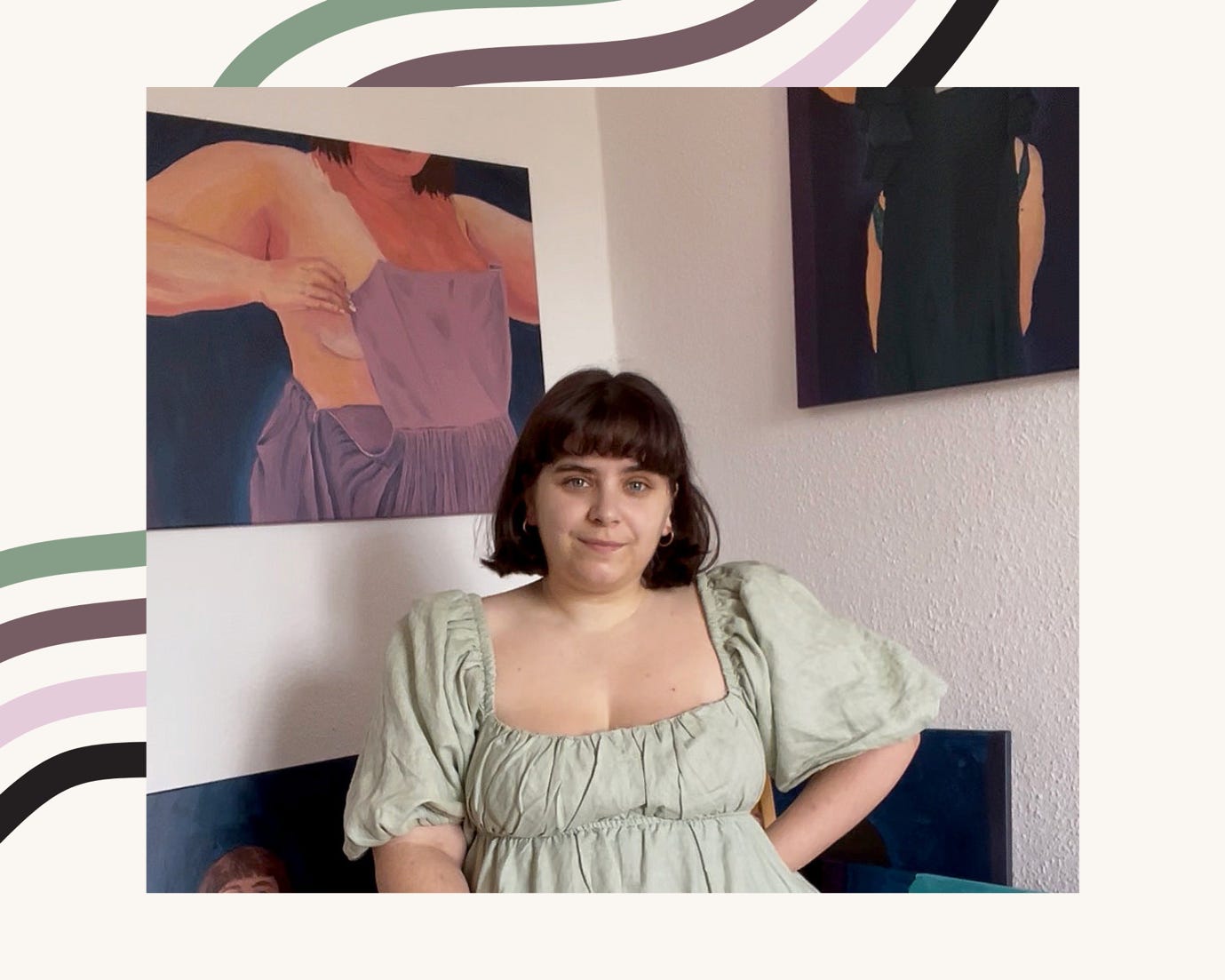
Photograph of Rebeca displaying some of her art in the background
This is part two of a video conversation I held with Rebeca, fine artist and all around inspiring person who focuses primarily on the fat experience in her art. Following the release of part one, we decided that so much was drawn from our discussion that it was only right to release part two for you.
In this article we discuss creative inspiration, Rebeca’s Fat Reinterpretations series, political aspects of art, and Rebeca shares encouragement and suggestions for anyone who creates art and is considering starting their own business. As always, responses to questions are in Rebeca’s own words.
An object of inspiration for Rebeca
You sent me this lovely video of a sculpture you have chosen as the object that you draw inspiration from in your daily life. I wonder if you would like to describe in your own words what that sculpture represents for you?
Creating the sculpture was a really interesting process. We started by preparing the base with iron and calculating how the balance of the figure would affect how it could stand and so on. I approached the teacher, we looked at my sketches and what I wanted to do, and he said, “You’re going to be fine. Yours is a stable figure”, and it just made me feel so warm inside because looking at her now, it is a stable figure. It really communicates this calmness to me, this grounding feeling.
Another aspect is that she has a lot of cracks in her body. The legs are very cracked, and this was something that I was trying to fight against during the sculpting process. The same teacher told me, “No, the cracks are in the exact right places. That’s where the body will fold. It only adds to the piece, so just let it dry that way”. I wasn’t convinced, but I went for it, and I love how it turned out.
This sculpture is very, very special and dear to me, and it is always next to me in my work area here. It communicates this calmness, this aspect of, “hey what you don’t plan and can’t control is not always necessarily a bad thing and sometimes it turns out great!”
You show so much bravery and courage to put your art out into the world and I wonder if we could discuss how this feels for you?
Absolutely. The internet is sometimes very welcoming. I love the community I have there. But you can’t control the algorithm and sometimes my art ends up on the wrong side of the internet and suddenly you’re hit with hate and it’s tough to navigate it. Especially in the very beginning I was posting without telling my friends about it. So, no one really knew what I was posting online. For me, it was easier to share this with strangers than with my direct family and friends at the time. Slowly, I also learned to open up about it and really show what I was working on and I feel so supported by everyone at the moment. But it’s definitely a practice of courage still to this day. You never know whose eyes it’s going to land in front of it and how they’re going to react, and what things they will say without realising there’s a person on the other side actually reading them.
You’ve mentioned in our discussion the history of linocutting and how it links to political elements in its history. I wonder if you see your work as political, yourself?
I think a lot of art is political and I think that’s a good thing. In Portugal we had the fall of our dictatorship over 50 years ago now, and revolutionary music was a big part of it. It was the signal that got the revolution rolling.
Art is only stronger when it is political because it is then also a tool for change. That’s 100% what I want my art to be. I feel very inspired both by the art, writings and music created in Portugal in the years preceding the fall of the dictatorship, but also in Europe with World War II. Kollwitz is definitely a reference when we talk about political printmaking, but also Taller de Gráfica Popular, a Mexican collective that created political woodcuts in the 20th century.
I believe art is so powerful and it starts conversations that can change minds. And there’s a lot going on in the world right now that needs to be talked about. Fatness is definitely a huge part of it for me, but I’m starting to incorporate other themes in my work as well such as burnout and rest, more recently. I hope I have a very long career and a long life, to explore many other topics, too.
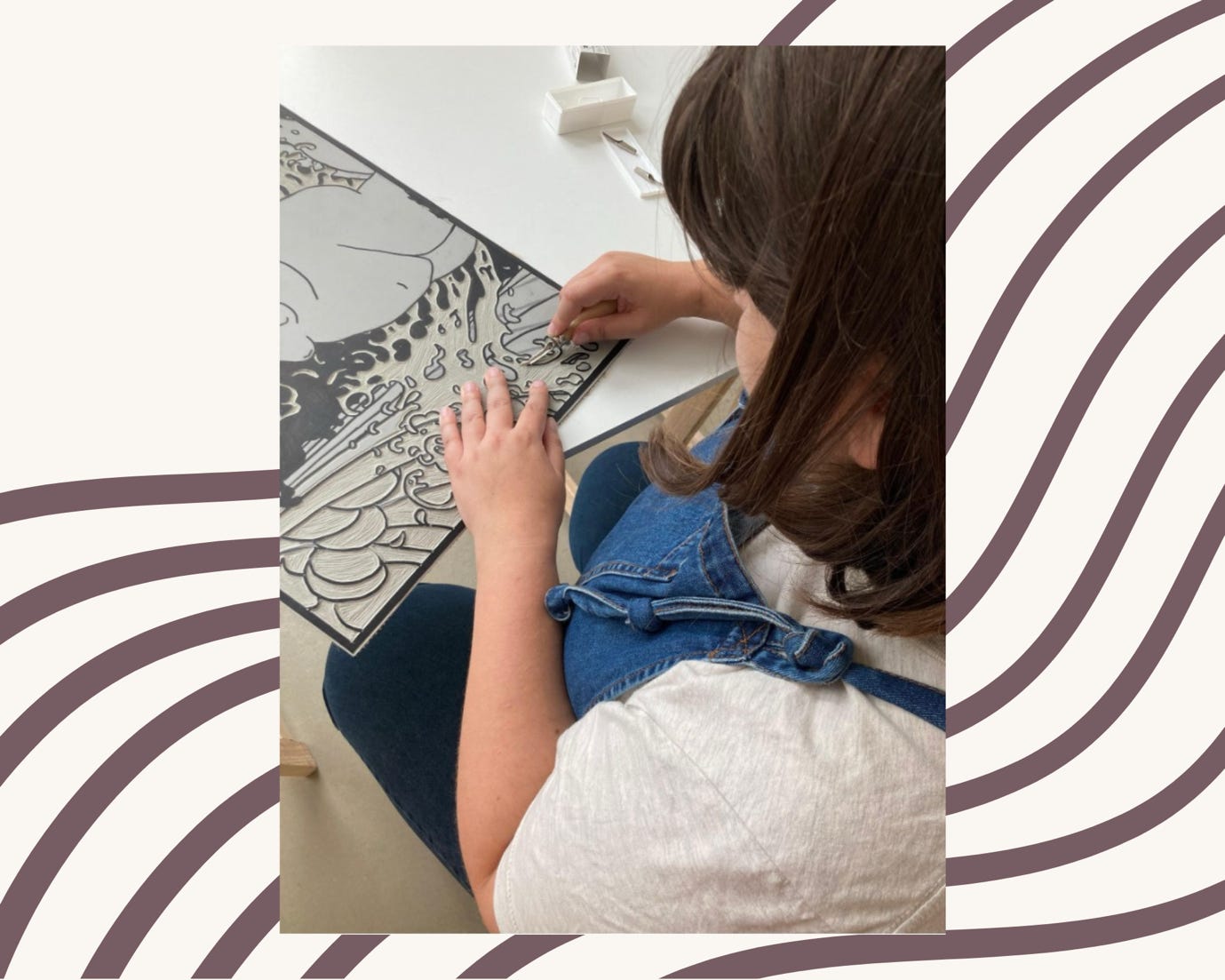
Photograph of Rebeca at work
This is making me think of your Fat Reinterpretations series as it’s incredibly powerful. I was looking up the original images of art against what you’ve recreated and it’s really striking.
(Fat Reinterpretations is Rebeca’s series where she has reinterpreted historic works of art in the public domain to replace the original straight-sized bodies depicted with fat bodies)
That was such an interesting series for myself as well, mentally. The first work I did was La Paresse (the original piece is by Félix Vallotton) and it’s the one where the difference is the most minimal. I remember trying out myself laying in bed and figuring out how much the curves might change. It didn’t change a lot, perhaps because my body was smaller than it is now and because when we’re laying down a lot of the fat is underneath us.
When this piece was first exhibited, a middle-aged man approached me stating that this was plagiarism. I explained that this is a reinterpretation of an artwork in the public domain and many big galleries do shows of just reinterpretations. He attempted a different attack: “But you didn’t change that much”, “where is the fatness here?” “Is the cat fat?” I regret entertaining his conversation and wish I had just walked away, but I found myself trying to argue about why this person is fat.
The second work I did was Goblin’s Market (the original piece is by Christina Rossetti) and one of the figures has a huge fat arm. It came from the conversation with this man. I wanted it to be undeniable that this work is about fatness! So the series has been a very emotional journey for me.
I remember finding the original work for Hymn of Pan (the original piece is by Percy Bysshe Shelley) and immediately thinking, “these need to be fat people!” The straight lines from the plants, all the nature surrounding them, it was calling for something to counter it; some soft lines, some curves.
It is so interesting to see something and not assume and accept that it’s thin by default, but instead to sometimes think, “this calls for fatness; fatness is needed here”. It’s such a powerful mindset to have and place to be in. It’s been really good for me as an artist and a person.
The roots of fatphobia are also connected to colonial history and blackness. In Fearing the Black Body: The Racial Origins of Fat Phobia, the author Sabrina Strings talks about the perception of fatness in Europe in the last centuries. Europeans often depicted people in art as voluptuous. Sugar was initially only accessible to rich people, so having a body that showed you’re able to consume such goods was a luxury. But once the slave trade started, spices were more readily available to the local population, and black bodies became more common in Europe, so the rich classes wanted to distance themselves from certain types of bodies. They wanted to be thin because sugar was available for everyone, so everyone could have bigger bodies. The racist theory of self-control linked to fatness and thinness started being developed. This was and still is a very, very problematic theory in so many ways.
Learning about this, my first thought was: “This is an awful part of our history. I wish so deeply that it had been different”. And I wondered, “can I try to write some parallel history, something that will inspire us to move differently in the future?” That’s definitely where the Fat Reinterpretations series came from. It hits you to see a historical piece that gives us a different perspective of how things could have been, and how beautiful it could have been as well. It gives us hope to build something better for the future and for the present, too.
A work of art which Rebeca is inspired by: Can I Have This Dance by Anthony Hurd
You can view this artwork on Anthony’s website: https://anthonyhurd.com/gay-dreaming-202425
Anthony’s work is incredible. The colours are beautiful, the way that he brings an idea to life I just find so warm and so joyful. I feel like he hits it just right in all his works.
It’s bittersweet because we know that in a lot of places it is not always possible for queer bodies to feel that free and comfortable. There are still so many places where people feel threatened. Anthony shows you how beautiful and colourful the world could be if all places could be welcoming and safe. And specifically, this painting connected a lot of course to my own past with dance – I find movement can be so freeing. It’s really just you and your body and gravity.
I can’t wait to see more of his work. I can’t wait for him to keep informing me through his work. It’s a great influence.
You’ve mentioned recently that you are presently playing with new artistic mediums and attended a recent course with Katie Pickerell. I don’t know if you wanted to describe what you’ve been exploring with at all?
I’ve been exploring painting with wax pastels, oil pastels, and oil sticks. I find the sensory experience really, really satisfying, but I’m still figuring out how I handle it on the canvas or on the paper because the amount of detail is just not the same and I do like the details in my work.
I’ve revisited ink during these last few months, which I’ve really enjoyed. I do think that ink might be in the future for me, so there might be some works coming everyone’s way in that medium.
I wondered what you’re drawing inspiration and nurture from in your life at the moment that nourishes your own well of inspiration you can then draw from, creatively?
I’m currently working on a different series connected to a very frustrating experience looking for a dress to attend a wedding and not being able to find one because it’s just so hard to shop in-person when you live in a bigger body. One day I was so fed up with it, I just had to do something about it. So that’s something that’s in the works and which I’ll hopefully be able to share this summer. A lot is direct personal experience, but of course I’m also inspired by the world around me.
My number one source of inspiration is seeing other fat people in the world. Be it strangers on the train or at the lake. Be it real people that I know in fat events here in Berlin, or in Vienna. Also, what I see online in fat liberation projects pages in America, in the UK, Spain and France. There’s so many fat people also working with photography, with sculpture. It’s beautiful and contributes to my pool of resources.
Water
The power of water for the fat body is important. In the world around us we’re often so heavy and there’s so many things that are not built for us and it’s such a struggle. But in water I feel like that almost goes away, because suddenly we’re floating. If anything, we even float better than thinner bodies, and it’s such a freeing feeling.
Growing up in Portugal, I lived five minutes away from the beach. It was a dream. And I’m so glad that in my current apartment, we live so close to a body of water so I can enjoy it a lot in summer. It’s a big part of my personal relaxation, and calming down process, for sure.
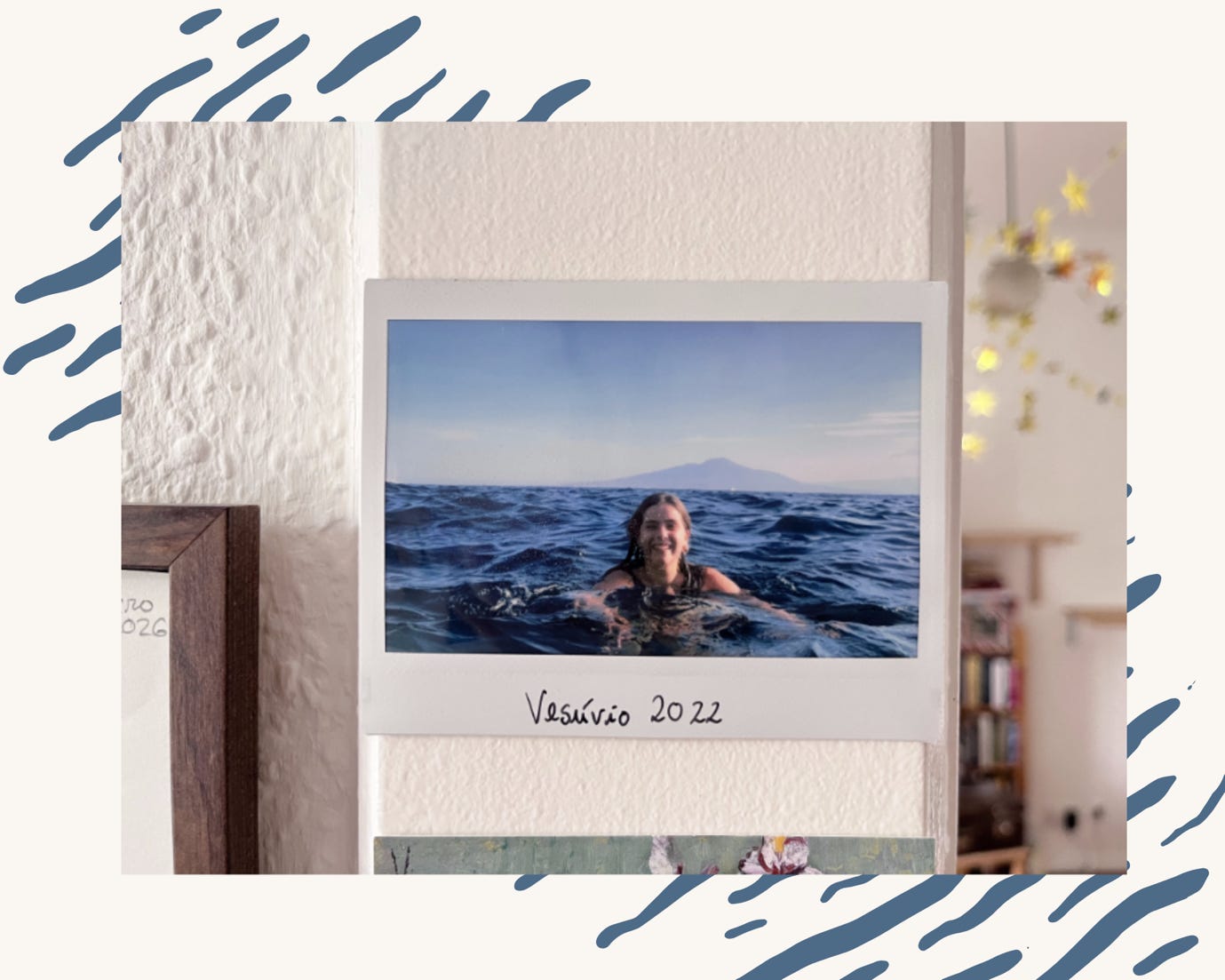
Photograph of Rebeca in the sea
If someone is creating art that they would like to build a business from, are there a few tips you could share about how they could move forward with that from what you’ve learned?
A little bit of business knowledge is useful no matter what country you’re in, because you’re gonna be responsible for much admin work. Especially when you work as a creative you want to save all of your energy for your art making and these tasks can really suck it out of you. If you can make that easier for yourself in any way, that is very helpful.
Figure out the admin work by connecting with other people about it. Write to another artist in your area and ask them your questions/for tips. Then you can really focus your energy on the creative side, the fun side of things.
Another aspect, which I personally only learned in therapy, was that if you are doing this, make sure you love it. It’s so challenging to be an artist nowadays, make sure you’re enjoying it and doing it for yourself. Be genuine about it because if you’re not, what’s the point? You might as well get a safe, stable job where you don’t have to run all these risks. But if we are doing it, then let’s do it genuinely and for the right reasons and in a way that makes us happy.
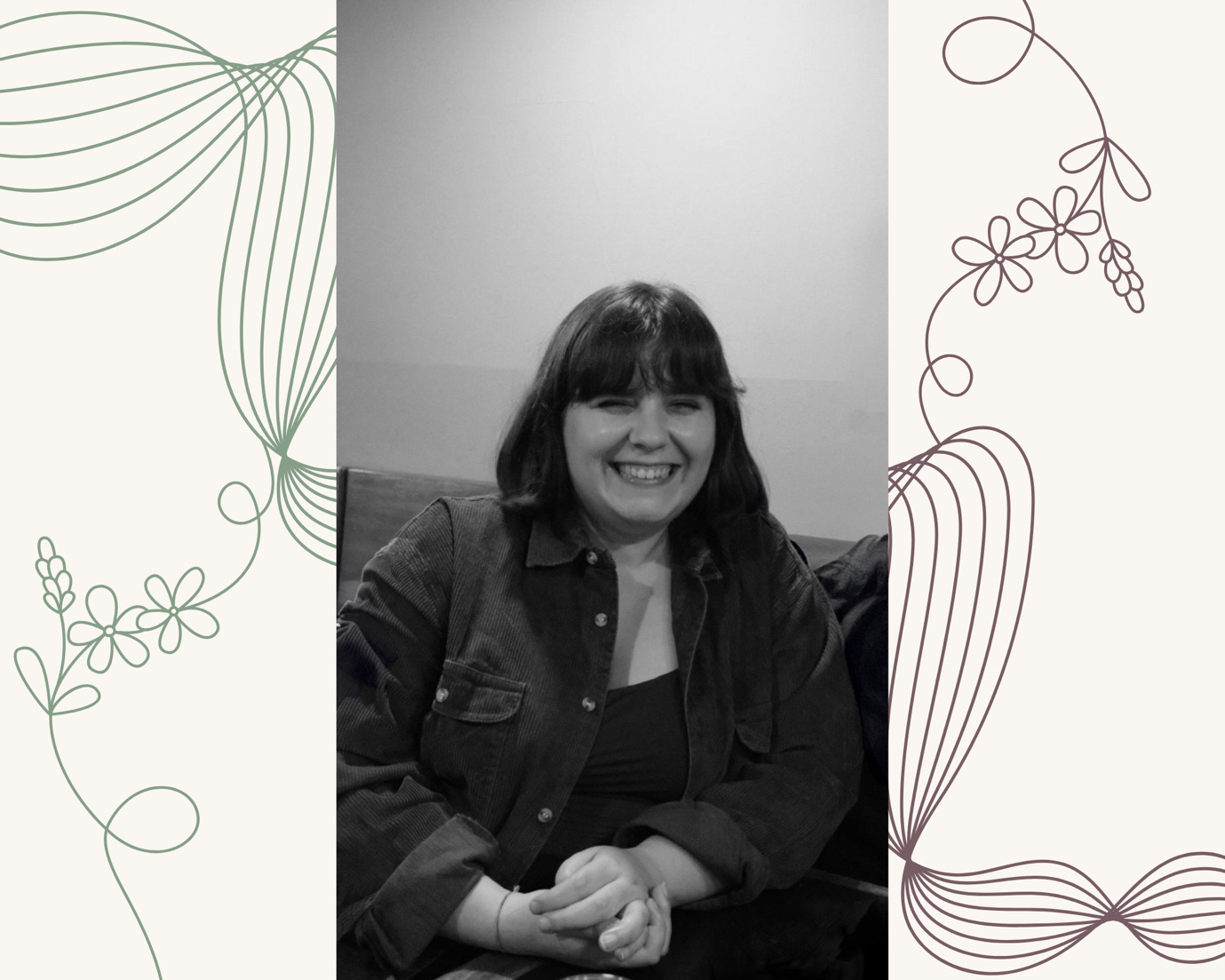
A Final Photograph of Rebeca
Details of the books Rebeca has shared with us today:
Art/Work – Revised & Updated. Everything You Need to Know (and Do) As You Pursue Your Art Career
Fearing the Black Body: The Racial Origins of Fat Phobia by Sabrina Strings
And finally, click to follow links to Rebeca’s Substack, website and Instagram
My heartfelt thanks to Rebeca for such a wonderful conversation, and I look forward to witnessing the next works of art she creates!
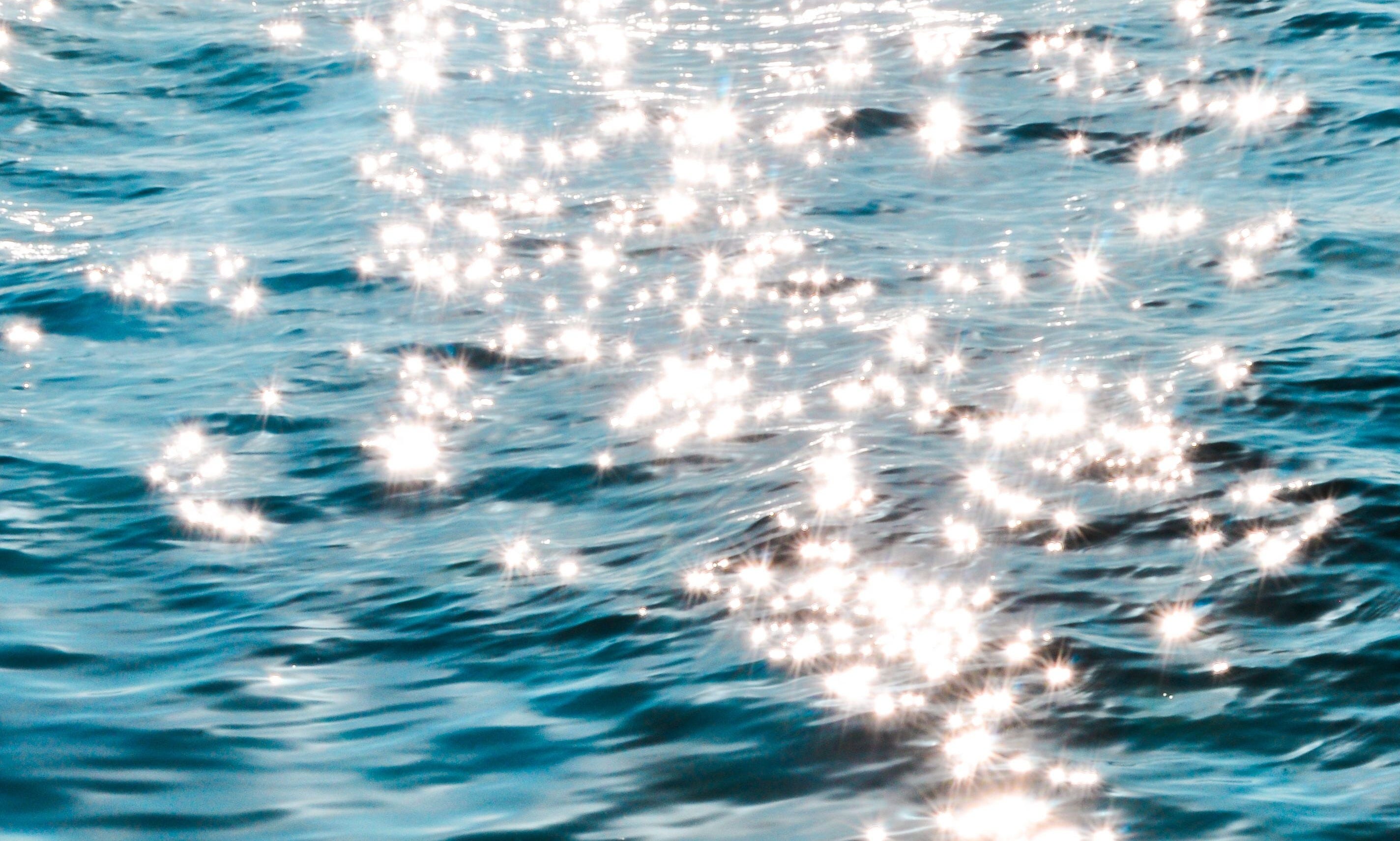
Image by Ninety Seven Years
Another marvelous interview! I will be sending this to all my artworld friends!